Main Takeaways
- Whitening gel does the actual chemical work of lifting stains. This happens with or without added light.
- A review of clinical trials found adding light during bleaching didn’t improve results, even when the light was LED.
- Some light-based methods have been linked to slightly more sensitivity, without a clear benefit to offset it.
- Peroxide concentration and treatment time matter far more than whether a kit includes a light.
- Consumer LED kits use small blue lights, mainly because they’re gentler and cheaper to include, not because they’ve been proven to boost results.
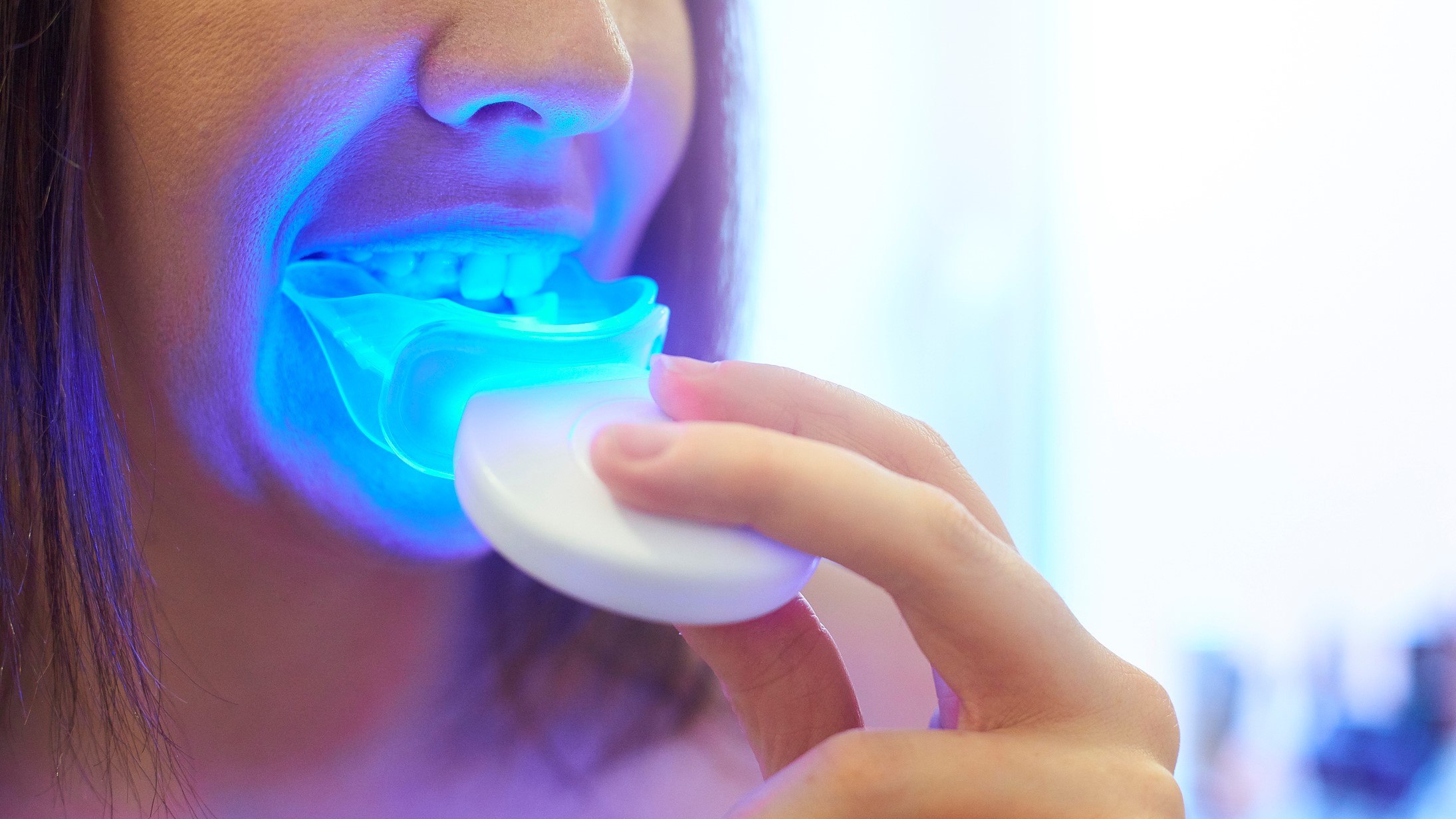
Whitening kits love to put their LED light front and center. The pitch is always some version of the same idea: the light activates the gel. It speeds things up. It makes teeth whiter, faster. It sounds like solid science. The glow-in-the-dark mouthpiece even feels like proof of serious engineering. But look closer at what actually drives the color change, and the light starts to look more like a selling point than a real ingredient.
How Teeth Whitening Works
Whitening gels are built around hydrogen peroxide or carbamide peroxide. Both are common in over-the-counter and professional treatments. Once applied, these compounds break down and release oxygen molecules. Those molecules work their way into the enamel. There, they break apart the compounds causing stains, whether from coffee, wine, tobacco, or just years of everyday eating and drinking.
This reaction happens on its own. It needs no light or heat to get started. Peroxide is what chemists call an oxidizing agent, and reactions like this depend on two things:
- Concentration: higher peroxide levels break down stains faster
- Contact time: the longer the gel stays on teeth, the more it can work
Neither factor depends on whether something is shining on the gel while it works.
What the Research Says About the Light
A large review pooled results from over 20 clinical trials. Each one compared professional teeth bleaching with light added against the exact same treatment without it. Some trials used LED. Others used halogen lamps or laser-based systems. Between them, they covered most of the light types dentists actually use. The outcome was consistent across the board. Adding light didn’t make teeth any whiter. It also didn’t reduce or increase sensitivity in any reliable way. The gel did the work either way. The light was along for the ride.
An earlier, smaller study looked specifically at an LED whitening system. It found a big color change after treatment, but that change happened during a professional-strength gel application and LED light. A follow-up phase used the same gel with no light at all. Results barely moved further. That suggests most of the whitening had already happened by that point, light or no light.
Why Consumer Kits Use Blue LED Anyway
If the light doesn’t add much, why is it in nearly every at-home kit? A few reasons explain it:
- Blue LED bulbs are cheap to manufacture and include
- They don’t get uncomfortably hot compared to older light types
- A glowing tray looks more advanced and photographs better for marketing
- It gives brands an easy feature to highlight on packaging and ads
None of that means the light is harmful. It just isn’t pulling the weight the marketing implies.
Could the Light Still Be Doing Something?
Not entirely nothing, but not much either. Some early lab research suggested heat and light might slightly speed up how fast peroxide breaks down. That’s likely where the original idea for light-activated whitening came from. In practice, the effect hasn’t shown up reliably in real clinical trials on real people.
Any extra brightness some users notice right after a lit session may come down to something simpler: temporary tooth dehydration. Teeth naturally lose some moisture during a whitening session. Dehydrated enamel can look slightly whiter and more opaque for a short time. It rehydrates soon after and returns to its baseline shade. That short-lived effect is easy to mistake for the light working its magic.
A Tradeoff Worth Knowing
Light isn’t automatically risk-free just because it’s marketed as gentle. A few things are worth weighing before choosing a light-equipped kit:
- A few studies have tied light-activated bleaching to increased tooth sensitivity in some patients
- Prolonged light exposure has been linked to mild gum irritation in certain cases
- The larger body of research found no consistent whitening benefit to offset either risk
If a kit’s light isn’t proven to help, it’s worth considering before paying extra for a light-equipped version.
How It Compares to Whitening Strips and Toothpaste
It helps to put LED kits in context alongside other common whitening options:
- Whitening strips press a thin layer of peroxide gel against teeth for a set time. They work the same way gel trays do, just without a light attached
- Whitening toothpaste typically relies on mild abrasives, and sometimes small amounts of peroxide, to remove surface stains rather than change the underlying tooth color
- Professional in-office bleaching uses much higher peroxide concentrations under dentist supervision. That’s why it tends to produce faster, more dramatic results than any at-home option
None of these methods depend on light to function. That reinforces the same point: the active ingredient is peroxide, applied at the right strength for long enough. The bulb is optional.
What to Look For When Buying a Kit
Since the light isn’t the deciding factor, focus on a few other things instead:
- Peroxide concentration listed on the packaging. Higher concentrations generally whiten faster, though they can also increase sensitivity
- Recommended contact time per application. Gels formulated for shorter sessions are usually less concentrated
- Your own sensitivity history. Anyone prone to sensitive teeth may want a milder formula, regardless of whether a kit includes a light
- Any dental association endorsement or clinical backing. This says more about effectiveness than an LED ever will
What Makes Whitening Work Better
Three things matter far more than whether a kit lights up. First, how much peroxide is in the gel. Second, how long it stays on your teeth. Third, how consistently you use it. A basic gel tray, used properly and regularly, will likely match a flashier LED kit. The gel was always doing the real work. The light just makes the process feel more high-tech.
Conclusion
The evidence points in one clear direction: teeth whitening comes down to peroxide, not light. Whether you’re using a professional in-office system or a drugstore kit, the gel breaks down stains. The LED attached to it is largely a marketing feature, not a functional one. That doesn’t make LED kits a bad choice, since many still contain effective peroxide formulas. But it does mean there’s no need to pay a premium just for the light. A well-formulated gel, used consistently, gets comparable results to a pricier light-equipped version, without the added risk of unnecessary sensitivity.
Sources
- “Can Blue Light Treatment Whiten Teeth?”, Healthline, 2021.
- “Why LED Lights Are Unnecessary for Effective Teeth Whitening: Debunking the hype behind a modern dental procedure“, Ultradent, 2025.