Key Takeaways
- HIFU facials heat the same deep support layer (the SMAS) that surgeons tighten in a facelift without a single incision.
- A review of 45 clinical studies found consistent skin-tightening improvements of 18–30%, with a strong safety record.
- Results build gradually over 8–12 weeks and can last a year or more once collagen remodeling kicks in.
- It’s best suited for mild-to-moderate sagging, not a stand-in for surgery on more significant laxity.
- At-home HIFU devices exist, but this is still fundamentally a professional, in-clinic treatment.
If you’ve spent any time on skincare TikTok lately, you’ve probably seen someone describe a HIFU facial as “the closest thing to a facelift without going under the knife.” That’s not just marketing spin — of all the non-invasive tightening technologies we’ve covered on this site, HIFU has some of the sturdiest research behind it. Here’s what’s actually going on beneath the surface, and what the evidence says you can realistically expect.
What’s Actually Happening Under Your Skin
HIFU stands for High-Intensity Focused Ultrasound, and the name is basically the mechanism. Here’s the process in order:
- Focused sound waves pass harmlessly through the top layers of skin.
- The energy concentrates at a specific depth, often the SMAS, the same fibrous support tissue a facelift surgeon would physically lift and stitch.
- That energy heats tissue to roughly 60–70°C in tiny, precise points, creating what practitioners call controlled thermal coagulation.
- Your body reads that heat as damage worth repairing, so fibroblasts kick into gear and start laying down fresh collagen and elastin.
This is a different approach than the RF (radiofrequency) devices, which tend to work closer to the surface. HIFU’s whole selling point is depth. Some professional machines reach as far as 4.5mm down, which is why it’s associated with actual lifting, not just surface smoothing. Devices typically offer multiple depth settings, commonly 1.5mm, 3.0mm, and 4.5mm, so practitioners can calibrate energy delivery to the treatment area.
What Does the Research Show?
A team of dermatologists pulled together the most comprehensive look yet at HIFU research: 45 clinical studies published between 2010 and 2024, covering thousands of patients. The findings were encouraging:
- Skin laxity improved somewhere between 18% and 30%, especially around the lower face, jawline, and under the eyes.
- For body areas like the abdomen, waist measurements dropped by roughly 2.5 to 4.5 cm on average.
- Fewer than 5% of patients reported anything beyond mild, temporary redness or swelling.
- Separate patient satisfaction surveys found over 90% of people were happy with results three months post-treatment.
Here’s the quick version:
| What’s claimed | How solid is the evidence | The short version |
|---|---|---|
| Skin tightening (face/jaw/neck) | Strong | Backed by dozens of studies, consistent 18–30% improvement |
| Body contouring | Moderate | Real, but smaller and more variable effects |
| Safety profile | Strong | Side effects are typically mild and short-lived |
| Instant, dramatic lift | Weak | Not supported — results build gradually |
Worth noting: results vary by skin type, age, and perhaps most importantly, the practitioner’s skill and the specific device used. Older or higher-quality FDA-cleared machines tend to show more consistent outcomes in the research than newer, unregulated alternatives flooding the med spa market.
What to Expect During Treatment
If you’ve never had one, a typical HIFU facial session goes something like this:
- The practitioner cleanses the area and applies a numbing cream or gel to minimize discomfort.
- An ultrasound gel is applied, similar to what’s used for a prenatal ultrasound, to help the device’s sound waves transmit properly.
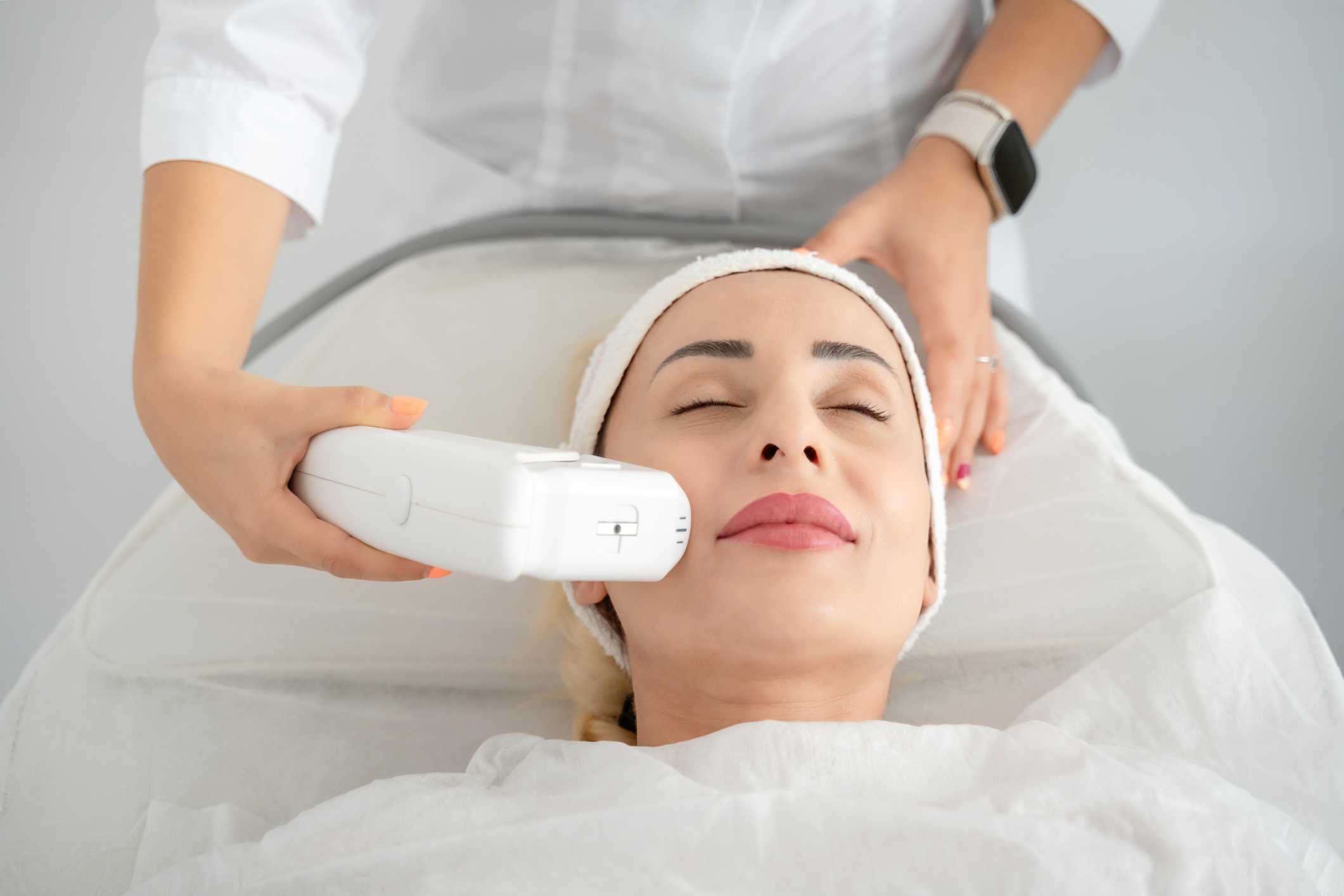
- The device is passed slowly over the treatment area in a grid pattern, delivering pulses of focused energy at set depths.
- A full-face treatment usually takes 30 to 90 minutes, depending on how many areas are being treated.
- There’s no downtime. Most people go straight back to their day, though some experience mild redness or a warm, sunburn-like sensation for a few hours afterward.
A Quick mention on At-Home Devices
You’ll come across at-home HIFU gadgets while researching this, and yes, they’re real and can produce mild results. But it’s worth being upfront that this is still overwhelmingly an in-clinic treatment. A few quick distinctions:
- Home devices operate at much lower power for safety reasons, so they can’t reach the SMAS layer the way professional equipment does.
- The realistic outcome is subtle, superficial firming, not the structural lift people usually mean when they say “HIFU facial.”
- Home devices typically require regular, ongoing sessions to maintain any effect, whereas a single professional treatment can last a year or more.
If you’re weighing a home gadget purely for touch-up maintenance between professional sessions, that’s a reasonable use case. If you’re expecting facelift-level results from a handheld tool, that’s not what the evidence supports.
The Timeline Nobody Tells You About Upfront
This is probably the most important expectation to set before you book anything: HIFU is not an instant-gratification treatment.
- Some people notice a mild lifting sensation right after their session, but that’s not the real result.
- The actual transformation — collagen rebuilding itself — ramps up over 8 to 12 weeks.
- Results typically peak around the three-month mark.
- Once collagen remodeling kicks in, effects commonly last 6 to 18 months, depending on age, skin condition, and your body’s natural collagen production going forward.
Many people opt for a yearly touch-up session to keep results maintained.
Who Benefits From This
HIFU tends to shine for people dealing with mild-to-moderate sagging, such as:
- A slightly softening jawline
- Mild laxity under the chin
- Fine lines and crepiness around the eyes
It’s a poor match for anyone with significant, advanced sagging because at that point, the physics of ultrasound just can’t replicate what a surgical lift accomplishes. A few groups should skip it altogether:
- Pregnant or breastfeeding individuals
- Anyone with active skin infections or open wounds in the treatment area
- People with pacemakers or metal implants near the face
If you’re comparing devices or shopping around, it’s worth revisiting our guide on decoding “clinically proven” and “FDA cleared” claims — HIFU marketing is no exception.
Q&A
Does a HIFU facial hurt?
Most people describe it as uncomfortable rather than painful — a hot, occasionally sharp or “zappy” sensation as the device passes over bone-dense areas like the jaw.
How is it different from a regular facelift?
No incisions, no anesthesia, no downtime — but also a more subtle, gradual result rather than a dramatic surgical correction.
Can you combine it with other treatments?
Yes. Several studies found that pairing HIFU with RF or microneedling produced better results than either alone, since they target skin at different depths.
How many sessions do most people need?
Often just one session per year for maintenance, though some practitioners recommend an initial course of two to three sessions spaced weeks apart for more noticeable results.
What does a HIFU facial typically cost?
Pricing varies widely by clinic and treatment area, generally ranging from a couple hundred dollars for a targeted area like under the eyes to well over a thousand for a full face-and-neck session — worth confirming with a licensed provider before booking.
Sources
- “A Systematic Review of High-Intensity Focused Ultrasound in Skin Tightening and Body Contouring”, Aesthetic Surgery Journal, 2025. https://academic.oup.com/asj/article/45/7/690/8106464
- “Are Home HIFU Machines Effective? The Truth About At-Home Devices”, Belis Laser. https://belislaser.com/faqs/are-home-hifu-machines-effective
- “What is HIFU? The Non-Invasive, Jaw-Tightening Treatment”, Women’s Health, 2024. https://www.womenshealthmag.com/uk/beauty/skin/a63168154/what-is-hifu-review/
- “HIFU Machines: Are They Worth the Money in 2025?”, Sure Beauty, 2025. https://surebeauty.com/blogs/beauty-tech-insights/hifu-machines-are-they-worth-the-money-in-2025
- “My Experience with HIFU (High-Intensity Focused Ultrasound)”, Paragon Aesthetics, 2021. https://paragonaesthetics.co.uk/my-experience-with-hifu-high-intensity-focused-ultrasound/