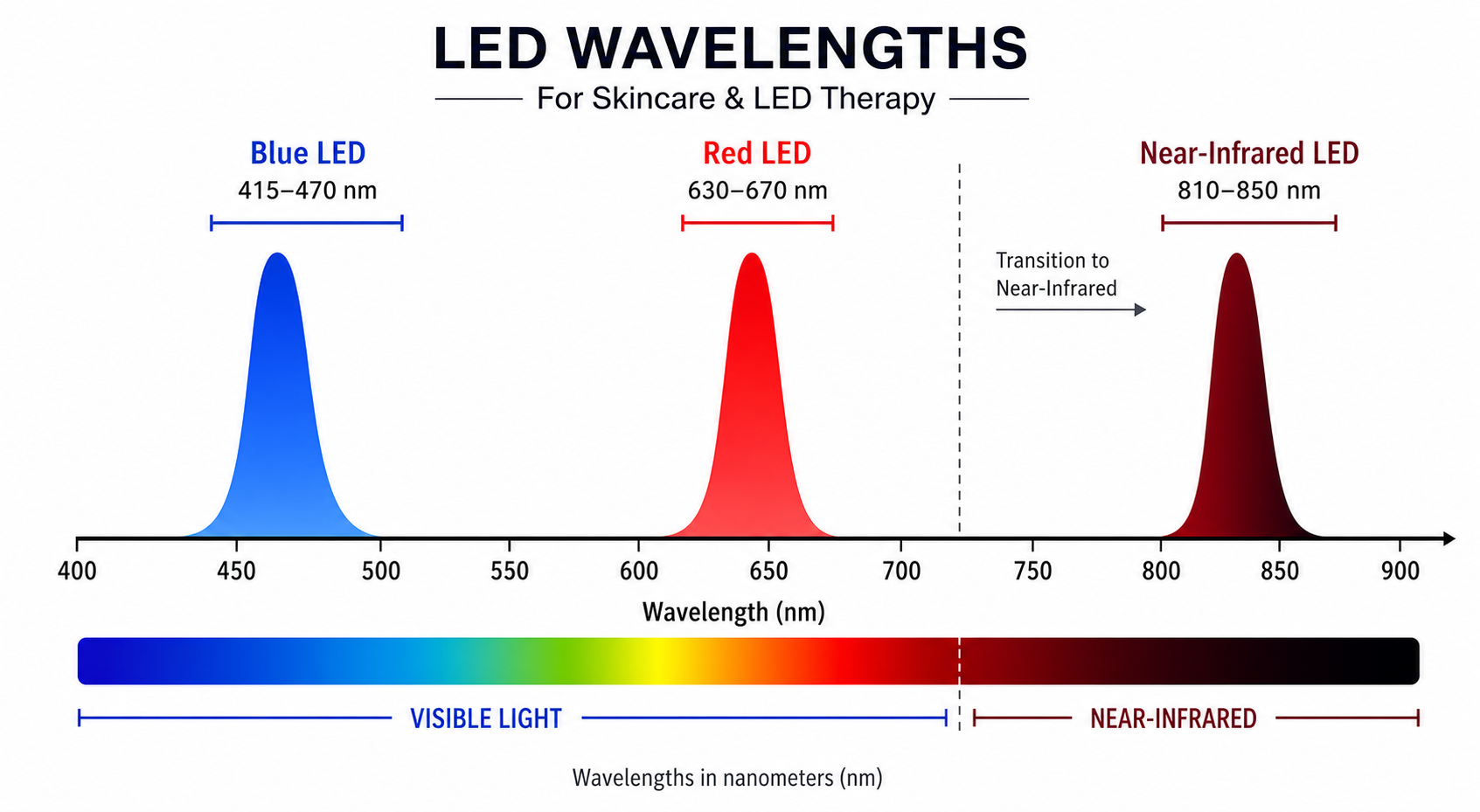
You’re looking at an LED device listing. It says “630nm Red, 850nm Near-Infrared.” Another says “660nm Red, 830nm Near-Infrared.” A third offers seven colors with no explanation. You have no idea whether these differences matter or whether the brand just picked numbers that sound credible.
This guide answers that question from the ground up. By the end, you’ll know what nanometers actually measure, why different numbers target different skin structures, and exactly when a 10nm difference is clinically meaningful versus marketing noise.
What “nm” Actually Means
Nanometers (nm) measure wavelength — the physical distance between peaks of a light wave. Longer wavelengths penetrate tissue more deeply; shorter wavelengths carry more energy per photon but are absorbed closer to the surface.
LED light therapy operates across two key ranges:
- Visible light (400–700nm): Colors from violet through deep red — blue, green, yellow, amber, and red
- Near-infrared (700–1100nm): Invisible to the eye but the most deeply penetrating range, where the deepest tissue effects occur
The number on your device is a physical measurement with direct implications for how deep the light travels and what biological structures it reaches.
Why Penetration Depth Is Everything
Different wavelengths are absorbed at different rates by the molecules in skin. Primarily melanin, hemoglobin, and water. A peer-reviewed study modeling light propagation through multi-layered skin tissue confirmed that penetration depth varies predictably with wavelength across the full therapeutic range. In practical terms:
- Blue light (415–470nm): Penetrates ~1–2mm — reaches the epidermis and upper follicle
- Green light (520–560nm): Penetrates ~1.5mm — reaches the upper dermis
- Red light (630–700nm): Penetrates ~2–10mm — reaches the dermis and fibroblasts
- Near-infrared (700–1100nm): Penetrates 10–20mm+ — reaches deep dermis, muscle, and joint tissue
The Optical Window
Between roughly 600nm and 1100nm lies what scientists call the “optical window,” which means the range where light passes through tissue most efficiently. Below 600nm, hemoglobin and melanin absorb most incoming photons before they travel deep. Above 1100nm, water begins absorbing light strongly and heat becomes a limiting factor. Within the optical window, wavelengths travel further with less obstruction, which is why all evidence-backed LED therapy for skin and tissue health uses wavelengths in this range.
The Major Wavelengths and What Each One Does
🔵 Blue (415–470nm) for Acne
Blue light’s primary mechanism is specific and well-documented: it photoactivates endogenous porphyrins produced by Cutibacterium acnes, the bacteria involved in inflammatory acne. When porphyrins absorb blue light photons, they generate free radicals that destroy the bacterial cell membrane.
The most clinically studied wavelengths are 415nm and 420nm. A study found that blue light at 415nm reduced inflammatory acne lesions by 76% over 12 weeks, and that combining it with red light at 660nm improved outcomes significantly further than blue light alone, achieving 76% reduction in inflammatory lesions.
Blue light penetrates to approximately 1–2mm, which is deep enough to reach sebaceous glands where bacteria reside but shallow enough that its anti-inflammatory effects are limited. This is why most professional protocols combine blue with red: blue kills bacteria, red reduces inflammation.
Best for: Inflammatory acne, oily skin. Not for: Anti-aging or deep tissue. The penetration depth doesn’t reach the relevant structures.
🟢 Green (520–560nm) for Pigmentation and Tone
A study on 505nm green LED found that daily 10-minute sessions over 8 weeks significantly inhibited melanin synthesis, improved the melanin index, skin brightness, and reduced dark spots without side effects. The mechanism involves downregulation of tyrosinase, a key enzyme in melanin production.
At 520–560nm, penetration is limited to approximately 1.5mm, which is not deep enough to reach fibroblasts in any meaningful quantity.
Best for: Surface pigmentation, uneven skin tone. Not for: Collagen stimulation or anti-aging.
🟡 Yellow/Amber (570–620nm) for Redness and Recovery
Yellow and amber wavelengths affect the vascular system by reducing erythema and supporting microcirculation. Clinically, they are most commonly used for rosacea management and post-procedure skin calming. Their anti-inflammatory properties make them useful in recovery protocols, but five controlled studies found no consistent increase in dermal collagen density when using amber light alone.
Best for: Rosacea-prone skin, post-procedure redness. Not for: Collagen building or acne.
🔴 Red (630–700nm) for Collagen and Fine Lines
Red light is the most clinically studied range in skin LED therapy. Its primary mechanism is the absorption of photons by Cytochrome c oxidase (CCO), a mitochondrial enzyme. This absorption restores electron flow in the mitochondrial chain, boosts ATP production, reduces oxidative stress, and activates transcription factors that regulate collagen synthesis.
Red light at 630–660nm penetrates approximately 2–10mm into skin tissue, which is deep enough to reach fibroblasts in the dermis and directly stimulate collagen and elastin production. A controlled 30-session clinical trial found statistically significant improvements in skin complexion, skin texture, collagen density (measured by ultrasound), and reduction in fine lines in participants receiving red light treatment.
Best for: Collagen stimulation, fine lines, skin firmness, wound healing, anti-aging.
The most versatile wavelength range for at-home skin health devices.
🟣 Near-Infrared (810–850nm) for Deep Tissue
NIR light is invisible but reaches 10–20mm into tissue, well past the dermis and into muscle and joint structures. The downstream results are similar: more ATP, reduced inflammation, improved repair, but at depths red light cannot reach.
A clinical study using 830nm and 633nm in combination found wrinkle reduction of up to 36% and improved skin elasticity of up to 19%. A randomized controlled trial on 850nm specifically found approximately 30% reduction in periocular wrinkle volume. Low-level NIR irradiation at 810nm has also demonstrated accelerated collagen deposition and cell proliferation in wound healing models.
Best for: Deep collagen remodeling, muscle recovery, enhanced anti-aging results when combined with red.
The 10nm Question: When Does It Actually Matter?
Cytochrome c oxidase has documented absorption peaks at approximately 660nm and 820–830nm. At these specific wavelengths, the enzyme’s photon uptake is maximized, meaning more biological effect per unit of light delivered.
- 660nm outperforms 630nm for collagen stimulation because 660nm sits closer to CCO’s red absorption peak. Studies confirm 630nm activates the pathway but with lower efficiency, and penetrates approximately 1–2mm less. For devices marketed specifically on collagen and anti-aging benefits, this difference is real.
- 830nm and 850nm outperform wavelengths further from the absorption peak partly because they sit within the tissue’s lowest chromophore absorption range — more photons pass through to depth rather than being captured by hemoglobin or melanin along the way.
Outside of these absorption peak zones, a 10nm shift matters less. A 2025 review noted that within a broad therapeutic range, dosing and irradiance adjustments can compensate for small wavelength differences and that direct head-to-head comparisons between neighboring wavelengths remain limited in the literature.
Quick-Reference Wavelength Chart
| Wavelength | Color | Penetration | Primary Benefit | Best For |
|---|---|---|---|---|
| 415–470nm | Blue | ~1–2mm | Kills acne bacteria via porphyrin activation | Inflammatory acne, oily skin |
| 505–560nm | Green | ~1.5mm | Melanin inhibition, tone evening | Surface pigmentation, brightness |
| 570–620nm | Yellow/Amber | ~2mm | Vascular calming, redness reduction | Rosacea, post-procedure recovery |
| 630–700nm | Red | 2–10mm | Collagen synthesis, ATP production, fibroblast activation | Anti-aging, fine lines, skin firmness |
| 810–850nm | Near-Infrared | 10–20mm+ | Deep collagen remodeling, muscle and joint repair | Deep wrinkles, tissue recovery, combined protocols |
Sources
- Wiegell, S.R., et al. “Depth Penetration of Light into Skin as a Function of Wavelength from 200 to 1000 nm.” Photochemical & Photobiological Sciences, 2019. https://onlinelibrary.wiley.com/doi/10.1111/php.13550
- Hamblin, M.R. “Unlocking the Power of Light on the Skin.” PMC / National Institutes of Health, 2024. https://pmc.ncbi.nlm.nih.gov/articles/PMC11049838/
- Biological and Therapeutic Responses of Human Skin to Different Wavelengths. PMC / National Institutes of Health, 2025. https://pmc.ncbi.nlm.nih.gov/articles/PMC12958274/
- Goldberg, D.J., Russell, B.A. “Combination Blue (415nm) and Red (633nm) LED Phototherapy in the Treatment of Mild-to-Moderate Acne Vulgaris.” Journal of Cosmetic and Laser Therapy, 2006. https://madrid.defelipe.com/wp-content/uploads/2020/11/Acne-Goldberg.pdf
- Blue-Light Therapy for Acne Vulgaris: A Systematic Review. PMC / National Institutes of Health, 2019. https://pmc.ncbi.nlm.nih.gov/articles/PMC6846280/
- Barolet, D., et al. “Photobiomodulation at 660nm Promotes Collagen Synthesis via Downregulation of HIF-1α Expression Without Photodamage.” PubMed, 2023. https://pubmed.ncbi.nlm.nih.gov/37074407/
- Weiss, R.A., et al. “A Controlled Trial to Determine the Efficacy of Red and Near-Infrared Light Treatment in Reduction of Fine Lines, Wrinkles, Skin Roughness, and Intradermal Collagen Density Increase.” Photomedicine and Laser Surgery, 2014. https://pubmed.ncbi.nlm.nih.gov/24286286/
- Frontiers in Photonics. “Red-Light Photons on Skin Cells and the Mechanism of Photobiomodulation.” Frontiers, 2024. https://www.frontiersin.org/journals/photonics/articles/10.3389/fphot.2024.1460722/full
- Optimizing Low-Level Light Therapy for Skin Rejuvenation. Digital Commons, Kansas City, 2025. https://digitalcommons.kansascity.edu/cgi/viewcontent.cgi?article=2015&context=studentpub
- Gemba Red. “The Wavelength Equivalence Guide to Red and NIR Light Therapy.” GembaRed.com, 2025. https://gembared.com/blogs/musings/the-wavelength-equivalence-guide-to-red-nir-light-therapy