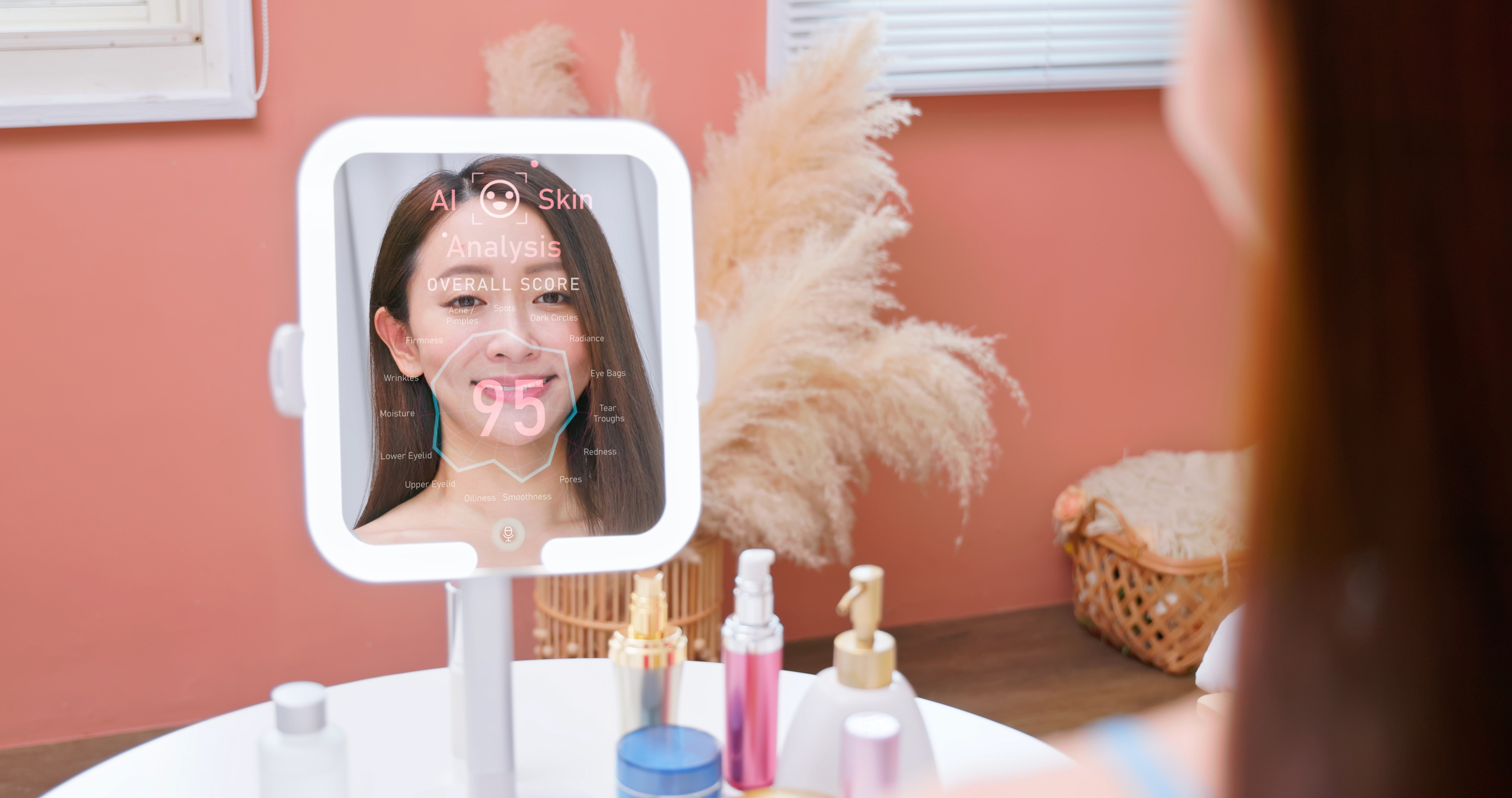
At CES 2026, AI skin mirrors and diagnostic scanners generated more buzz than almost any other beauty category. The promise is compelling: point a device at your face and receive a precise, data-driven breakdown of your skin’s condition in seconds. Back home, though, a lot of people are staring at an app telling them they have “moderate hyperpigmentation” and “early signs of aging” and wondering whether to trust it.
This article gives you the framework to answer that question, not just for one device, but for any AI skin analysis tool you encounter.
Three Technologies, Three Different Capabilities
“AI skin analysis” is an umbrella term that covers three distinct underlying technologies. They are not equivalent.
| Technology | How It Works | Where It’s Used |
|---|---|---|
| Computer Vision | AI pattern-matches a standard camera image against a labeled training dataset | Most smartphone apps and home devices |
| Multispectral Imaging | Captures skin data across UV, visible, and near-infrared wavelengths simultaneously, revealing subsurface information | Clinical tools (e.g., Visia), advanced home accessories |
| Spectroscopy | Measures light reflected or absorbed by skin tissue to determine biochemical composition (hydration, sebum, melanin) | Professional and research settings |
The gap between these methods matters enormously. A consumer app using compressed smartphone photos and a clinical system using multispectral imaging under controlled lighting are not measuring the same things.
Consumer-Grade vs. Clinical-Grade
The Visia Complexion Analysis System, the standard in many dermatology clinics, captures skin data across eight parameters: spots, wrinkles, texture, pores, UV spots, brown spots, red areas, and porphyrins (a bacterial activity marker). It uses three distinct lighting modes, standard, cross-polarized, and UV, and rotates around the face to capture left, right, and frontal views under precisely controlled conditions.
Consumer apps and home devices approximate some of these parameters but face structural limitations that clinical tools don’t:
- Variable lighting captures noise that controlled clinical environments eliminate
- Single camera angle misses the lateral skin data a rotating system provides
- No subsurface data because standard cameras cannot capture UV spots, vascular patterns, or bacterial activity without multispectral capability
- No validated population norms because consumer apps rarely compare results against a clinically validated baseline database
This doesn’t make consumer tools useless. It means their output should be interpreted accordingly.
What the “AI” Is Actually Doing
This is the most misunderstood element of AI skin analysis, and understanding it changes how you read the results.
Most consumer skin AI uses machine learning pattern-matching: the model has been trained on thousands of labeled skin images and learned to recognize different skin conditions and concerns visually. When you submit a photo, the model compares your image to its training data and returns a probability-weighted classification.
Output quality is directly constrained by training data quality, and this is where a well-documented problem emerges. Multiple peer-reviewed studies have found that AI dermatology models trained predominantly on lighter skin tones perform measurably worse on darker skin tones. A 2025 study found that across four leading AI image models, 89.8% of generated dermatological images depicted light skin tones, with significant accuracy drops on darker skin phototypes. For consumers with Fitzpatrick skin types IV through VI, it directly affects whether a given tool’s output is reliable for them.
What AI Skin Analysis Is Genuinely Useful For
These tools deliver real value in the right contexts:
- Progress tracking over time — capturing consistent images at regular intervals to document skin changes or treatment responses
- Broad skin type orientation — identifying oily, dry, combination, or sensitive patterns that guide general product selection
- Flagging visible surface concerns — texture irregularities, enlarged pores, surface dehydration, and uneven tone worth paying closer attention to
- Habit support — data visibility can motivate more consistent skincare routines
Where It Falls Short
The limitations are equally real and less often disclosed:
It cannot diagnose conditions. Rosacea, eczema, and melasma require clinical assessment. AI skin lesion analyzers for serious conditions remain tightly regulated by the FDA as prescription-only devices for trained physicians, precisely because diagnostic stakes are high.
Product recommendations carry a conflict of interest. Many AI skin analysis tools are built by, or commercially partnered with, brands whose products the tool then recommends. A peer-reviewed review of AI-powered skincare recommendation systems published in 2024 noted that the commercial architecture of most recommendation platforms creates structural incentive misalignment between user benefit and brand promotion. When an AI “diagnostic” routes directly to a product purchase page, the analysis is not neutral.
The regulatory language is intentionally vague. Under the FDA’s revised General Wellness Guidance issued in January 2026, AI skin tools can avoid medical device regulation as long as they stay within cosmetic or wellness claims. The moment a tool claims to detect or diagnose a condition, it crosses into medical device territory. Most consumer apps are careful with language for exactly this reason, which also means their disclaimers are often deliberately unclear about what the tool can actually do.
Five Questions to Ask Before Trusting Any AI Skin Tool
- What imaging method does it use? Photo analysis, multispectral, or spectroscopy — each has a different accuracy ceiling.
- Has the AI been independently validated? Look for published validation data, not just the brand’s own accuracy claims. Specifically: on which skin tones was it validated?
- Are the product recommendations linked to the brand’s own catalogue? If yes, treat them as starting points for research, not prescriptions to follow.
- Does it describe observable characteristics or claim to diagnose conditions? Description is reasonable; diagnosis requires clinical oversight.
- What are the capture conditions? Controlled lighting and standardized positioning produce more reliable data than unconstrained selfies.
The Bottom Line
AI skin analysis is a useful tracking and orientation tool. The more a tool claims to know with certainty, and the more directly it routes that certainty into a product purchase, the more important it is to ask how it actually knows what it claims to know. “AI-powered” is not the same as “clinically validated,” and that distinction matters before you decide to purchase.
Sources
- BeautyMatter. “The 19 Most Exciting Beauty and Wellness Innovations at CES 2026.” BeautyMatter.com, January 2026. https://beautymatter.com/articles/the-19-best-beauty-and-wellness-launches-at-ces-2026
- ScanSkinAI. “How AI Skin Analysis Works.” ScanSkinAI.com, 2026. https://www.scanskinai.com/blog/how-ai-skin-analysis-works
- Advanced Dermatology Care. “VISIA Complexion Analysis — Patient Information.” ADCDerm.com. https://adcderm.com/wp-content/uploads/2016/08/VISIA_Pt_Web_Info_secure.pdf
- PMC / NIH. “The Mechanism and Application of Computer-Assisted Full Facial Skin Imaging Systems.” PMC.NCBI.NLM.NIH.gov, 2023. https://pmc.ncbi.nlm.nih.gov/articles/PMC10988667/
- PMC / NIH. “Exploring the Diagnostic Capability of Artificial Intelligence in Dermatology for Darker Skin Tones.” PMC.NCBI.NLM.NIH.gov, 2025. https://pmc.ncbi.nlm.nih.gov/articles/PMC12624499/
- Winkler, J.K., et al. “AI-Generated Dermatologic Images Show Deficient Skin Tone Diversity and Poor Diagnostic Accuracy.” Journal of the European Academy of Dermatology and Venereology, 2025. https://pubmed.ncbi.nlm.nih.gov/40668069/
- Chromara Beauty. “How Does the FDA’s General Wellness Guidance Affect Beauty Hardware?” ChromaraBeauty.com, May 2026. https://chromarabeauty.com/fdas-general-guidance-affect-beauty-hardware/