Main Takeaways
- Light-based home devices are most relevant to gradual, pattern-like thinning, not every form of shedding.
- Caps and helmets are usually easiest to use consistently because they are hands-free and cover a larger area at once.
- Combs and bands can be more targeted, but demand more time and careful positioning.
- LED brushes can be useful grooming tools, but their hair-growth claims should not be assumed to match those of established laser-device formats.
- Documentation, fit, routine, and the reason for hair loss matter more than anything else.
At-home hair growth devices are easy to find and difficult to compare. A search brings up laser caps, helmets, combs, bands, LED brushes, and plenty of before-and-after photos. Some use low-level light therapy, a technology studied mainly for pattern hair loss. But this is not a category where more lights automatically mean better results, or a device will work for everyone.
This guide does not aim to promote any product. It explains how the main device formats differ, what they may realistically offer, and what to check before spending money on hair growth products.
Start With the Type of Hair Loss
Before comparing devices, ask what you are trying to address. At-home low-level light therapy (LLLT) is most often considered for androgenetic alopecia, also called pattern hair loss. This tends to develop gradually: a widening part, less density through the crown, recession around the temples, or steadily finer-looking hair.
That is different from sudden shedding after illness, stress, medication changes, childbirth, major weight loss, or restrictive dieting. It is also different from patchy loss or a scalp that is painful, inflamed, very itchy, scaling, or tender.
A home device cannot diagnose why hair is changing. If loss is sudden, patchy, painful, or paired with scalp symptoms, seek an evaluation before treating it as a device-shopping problem. You can explore the wider distinction between scalp treatments and at-home tools in our guide to scalp tech.
What Light-Based Devices Do
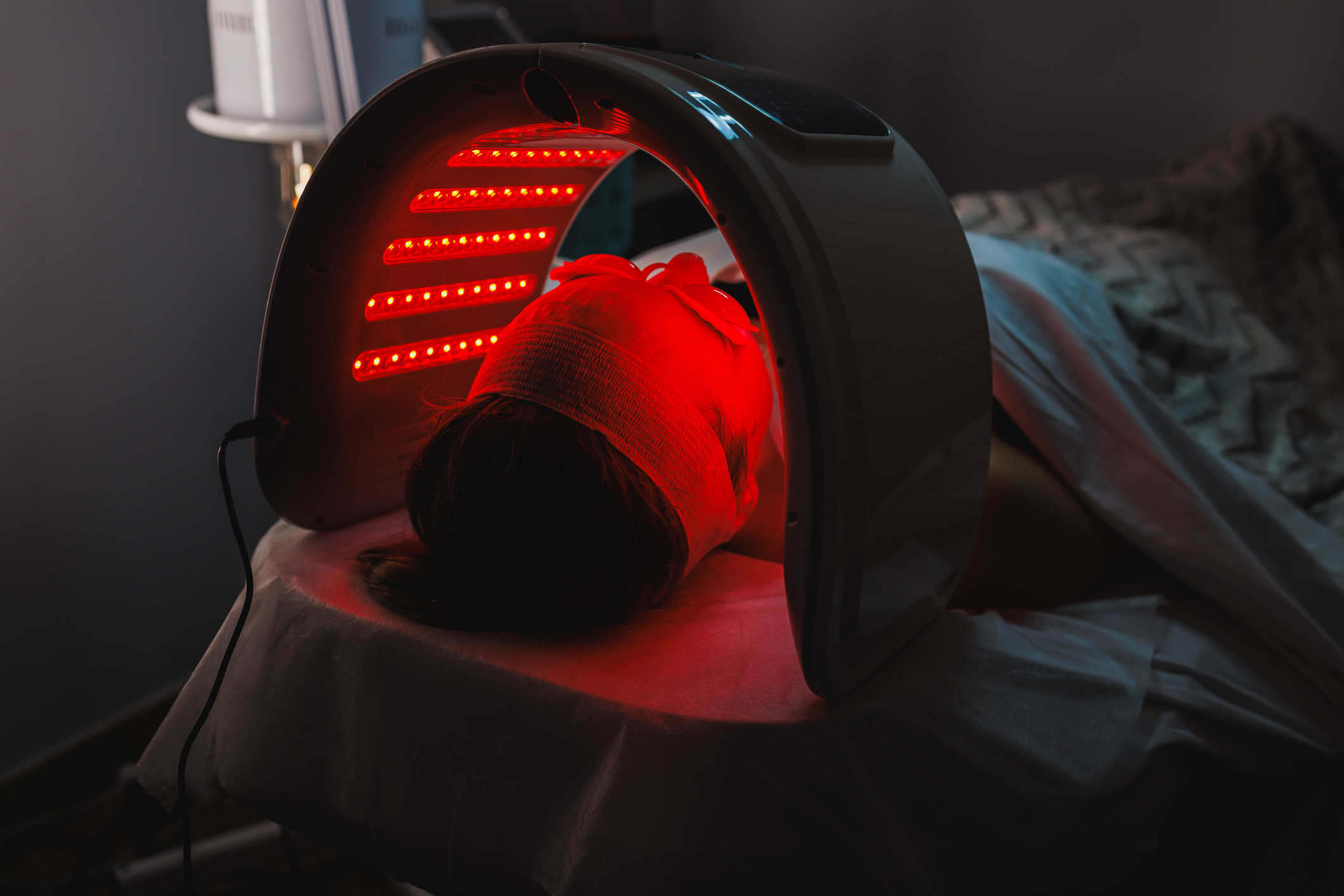
Most at-home hair-growth devices use low-level light therapy, often called LLLT. Product pages may instead say red-light therapy or photobiomodulation. The intended purpose is to deliver low-level red or near-infrared light to the scalp in support of follicle activity. It is not comparable to a high-powered clinic laser, and it cannot diagnose the cause of hair loss or instantly create density.
A systematic review found that home-use light and laser devices may improve hair-density outcomes in people with pattern hair loss. The important issue is that the devices, protocols, study methods, and results varied considerably. Evidence for a specific finished device is not automatic evidence for every cap, comb, brush, or light-emitting scalp tool.
Laser Cap, Helmet, Comb, Band, or LED Brush?
The best format is not automatically the one with the highest diode count, the shortest stated treatment time, or the highest price. The more useful question is whether a device provides practical scalp coverage in a routine you can realistically repeat for months.
Laser caps
Laser caps are usually flexible, hands-free devices worn during a timed treatment session. A cap-style product such as CapillusPro illustrates how this format works.
The main appeal is convenience. You do not need to part your hair repeatedly or move a tool around the scalp, which can make a cap easier to use consistently. But a cap is not the best choice just because it covers more area. Fit, comfort, hair density, treatment schedule, and whether the device works with your daily routine still matter.
Helmet-style devices
Helmet-style devices are more structured than flexible caps and are designed to sit over a larger scalp area. The iRESTORE Elite is one example of this hands-free format.
This may suit someone who wants a dedicated routine without manually moving a device through the hair. The tradeoffs are usually price, bulk, and storage. Before buying, consider whether the device feels realistic to wear as often as its treatment schedule requires. A device that looks impressive online but is uncomfortable or inconvenient will be difficult to use consistently.
Laser combs
Laser combs are handheld tools that are moved gradually through the hair in sections. The Ultima 12 Classic LaserComb is an example of this format.
A comb gives the user more direct control over placement and may appeal to someone with thinning concentrated around the hairline, temples, or crown. The limitation is that it demands more active effort than a cap or helmet. With very thick, long, curly, or dense hair, it may take patience to make sure the device reaches the scalp rather than simply passing over the surface of the hair.
Laser bands
Laser bands are positioned across one section of the scalp and then moved to treat other areas. They are generally more compact than a helmet and less hands-on than a comb, but they are not fully passive like a cap.
This format may work well for someone who wants a shorter, portable routine and does not mind following repositioning instructions. The main question is whether you will remember to move the device through the required treatment zones often enough for the routine to be meaningful.
LED hair brushes
LED hair brushes combine brushing with light exposure and may also include vibration, massage, or scalp-care functions. They can be appealing because they fit naturally into a familiar hair-care routine.
However, a brush that makes hair feel smoother, detangles more gently, or reduces snagging should not be treated as a proven hair-growth device. Less breakage can make hair look fuller over time, but that is different from demonstrating a measurable change in hair density. Our FLIP Play review explores that distinction between immediate manageability benefits and longer-term hair-growth expectations.
What Matters Before You Buy
Product pages often lead with diode counts, wavelengths, treatment times, and clinical-sounding language. Some of those details can be useful, but no single number should decide your purchase.
Start with the exact intended use. Is the product specifically marketed for gradual pattern hair loss, or is it a general red-light, scalp-wellness, or grooming tool? Those categories should not be treated as interchangeable.
Then examine the specific documentation behind the device. If a product says it is FDA-cleared, check which exact model that statement applies to and what the stated use is. FDA clearance is not the same as FDA approval, and it does not mean every claim on a current product page has been independently proven.
Next, think about coverage and treatment burden. A cap, helmet, comb, or band can all sound practical in theory. But a good device on paper is not useful if it pinches, feels heavy, requires more time than you have, or becomes something you stop using after a few weeks.
Finally, check the return policy, warranty, replacement options, and customer support before purchasing. At-home hair-growth devices are usually a longer-term investment. A device you can use comfortably and consistently matters in the long run.
Who Should Pause Before Buying?
A light-based device may be a reasonable option for gradual, pattern-like thinning, particularly for someone who wants a non-drug addition to an existing plan and can stick with a routine. It is less appropriate as a first response to sudden shedding, distinct bald patches, scalp pain, marked itching, inflammation, or a change that began soon after a medication or health event.
It is also worth pausing if the purchase is driven by anxiety over a short period of shedding. Hair naturally moves through growth and shedding cycles, and a few weeks of extra hair in the brush does not automatically mean a device is needed. A clinician can help identify the cause of loss and discuss whether a device, medication, blood testing, or a different approach makes sense. This is especially important when hair loss is causing distress or progressing quickly.
Think in Months, Not Weeks
Hair growth is slow. A brush or grooming-oriented tool may make hair feel smoother or reduce tangling quickly, but that is not the same as more hair density. Assessing a device for pattern thinning requires months of consistent use, not a few sessions or a few weeks. If you want to track progress, take photos in similar lighting, from the same angle, with the same part and a similar hair condition.
Conclusion
At-home hair-growth devices are most worth considering for people with gradual, pattern-like thinning who can treat them as a long-term routine rather than a quick fix.
A cap or helmet is often the simplest format for consistent, hands-free use. Combs and bands may suit someone who wants more direct placement, a compact device, or a lower initial cost. LED brushes can be helpful grooming tools, but should be evaluated more cautiously when the goal is actual hair growth.
Choose the device with clear documentation, an appropriate intended use, realistic treatment demands, and terms that protect you if it does not fit your routine—not simply the boldest specifications.