
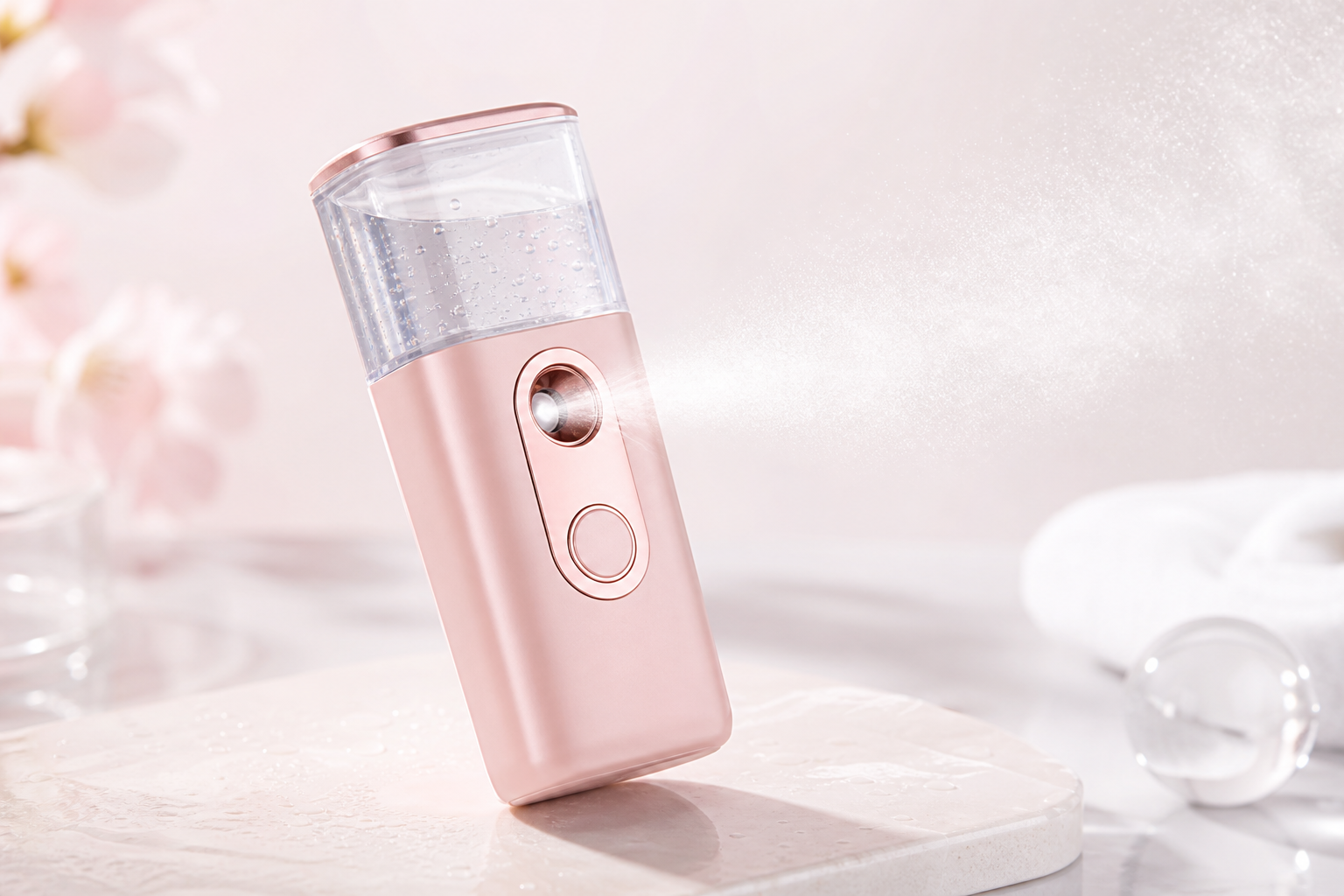
“Ion-infusion” and “nano mist” are two of the most-used phrases in beauty device marketing. They’re also two of the most misunderstood — not because the underlying science is fake, but because the gap between the real science and what budget beauty devices actually deliver is enormous. Before you spend money on either, here’s what’s actually going on.
Part 1: Ion Infusion Devices
What Brands Claim
Ion infusion wands typically make the following promises:
- Drive skincare ingredients “deeper into the skin” using positive or negative ion charges
- Cleanse skin of “negatively charged impurities” using positive ion current
- Boost active ingredient absorption by 2x, 3x, or more
- “Detoxify” pores through ionic attraction
Most devices feature a metal contact surface and a +/− polarity toggle, sold anywhere from $20 to $200.
The Real Science: Iontophoresis
The science behind ion-driven ingredient delivery is real — it’s called iontophoresis. Here’s how the legitimate version works:
- A direct electrical current is passed through a solution on the skin.
- Charged (ionic) molecules are driven across the skin barrier by the current.
- Like charges repel, so a positively charged current pushes positively charged molecules deeper into tissue.
This technique is used clinically to treat excessive sweating and deliver anti-inflammatory drugs into tissue. It’s legitimate, reproducible, and well-studied.
Where Consumer Ion Wands Fall Short
For iontophoresis to actually work, three conditions must all be met simultaneously:
- A complete electrical circuit — current must flow through the skin from one electrode to another
- Sufficient electrical power — typically requiring medical-grade equipment, not a $30 wand running on a USB charge
- The correct molecular profile — only ions of the right size, charge, and solubility can be driven through skin; most molecules in everyday skincare products don’t qualify
Consumer ion wands typically fail on all three counts:
- They act as only one pole of a circuit. There is no return electrode completing the loop through the skin.
- They operate at currents far below what clinical iontophoresis requires.
- They make no attempt to verify whether the serum being “infused” contains the right ionizable molecules.
Cosmetic chemists who have examined popular ion devices have been direct: unless a brand can demonstrate their device meets these three conditions, the deep-infusion claim is pseudoscience.
What Ion Wands Can Actually Do
They’re not completely useless. Mild galvanic current can deliver some real, if modest, benefits:
- A mild circulation-stimulating effect on the skin surface
- Temporary softening of the stratum corneum, making skin slightly more receptive to products applied right after
- A pleasant, subtle tightening sensation during use
These are legitimate. They are just not the same as driving active ingredients millimeters into the dermis.
The “Negatively Charged Dirt” Claim
One of the most common claims is that positive ions “attract and remove negatively charged impurities” from skin. The problem? The mechanism brands describe is essentially backwards relative to how skin charge actually works. A standard gentle cleanser removes surface debris far more reliably — no ion charge required.
Part 2: Nano Mist Devices
What Brands Claim
Nano mist sprayers use ultrasonic vibration to atomize water or serum into ultra-fine particles — marketed as 0.3 microns or smaller. Common claims include:
- Particles “penetrate deeper into skin” than regular sprays
- Water molecules are “10x smaller” for superior absorption
- Better hydration than conventional toners or mists
- Enhances the absorption of products applied afterward
The Real Science
What is true:
- The atomization technology is real — ultrasonic vibration does produce dramatically finer particles than pump or aerosol sprays
- The particles are genuinely small, cool on contact, and feel noticeably different from a manual spritz
- Surface moisture delivery is immediate and pleasant
What is not supported:
- The skin’s outermost layer — the stratum corneum — is specifically designed to prevent water and most molecules from freely passing through it
- Whether a droplet is 0.3 microns or 30 microns, absorption is governed by the skin barrier’s integrity, not droplet size
- There is no peer-reviewed evidence that nano-sized droplets bypass the stratum corneum more effectively than regular water
A cosmetic dermatologist consulted by New York Magazine put it plainly: “Anything cold will assist your skin in retaining moisture, constricting blood vessels, and tightening pores.” That’s the real mechanism — surface-level, but genuinely useful.
Honest Uses for a Nano Mister
A nano mister is legitimately good for:
- Refreshing skin mid-day without disturbing makeup
- Setting makeup with a fine, even mist
- Soothing mild irritation after a facial or light procedure
- Prepping skin before applying the next product in your routine
Why These Claims Keep Getting Made
- In the US, cosmetic devices don’t require pre-market proof of efficacy from the FDA
- Brands only need to show their device is physically safe, not that it performs as claimed
- As long as language stays in cosmetic territory (“helps improve the appearance of”), no supporting evidence is required
Researchers have specifically named this practice “scienceploitation” — using real scientific terms in exaggerated or misleading ways to sell products. One widely cited study found that among scientific beauty claims analyzed, 86% were considered vague or unsupported by an independent review panel.
Conclusion
| Device | Legitimate Benefit | What It Won’t Do |
|---|---|---|
| Ion infusion wand | Mild circulation boost; surface skin softening | Drive most skincare actives meaningfully deeper into skin |
| Nano mist sprayer | Surface hydration; cooling; makeup setting | Penetrate the stratum corneum; outperform a regular toner for long-term hydration |
Both devices can be enjoyable parts of a routine — just not for the reasons their packaging suggests. If deep ingredient delivery is genuinely your goal, the evidence-backed options are:
- Prescription retinoids — clinically proven to penetrate and remodel skin at depth
- Low-molecular-weight hyaluronic acid — small enough to reach deeper skin layers
- Clinical microneedling — physically creates channels for ingredient delivery
- Clinical iontophoresis — the real, professional version of what ion wands claim to do
Sources
- Physiopedia. “Iontophoresis.” Physio-Pedia.com. https://www.physio-pedia.com/Iontophoresis
- WebMD. “What to Know About Iontophoresis for Hyperhidrosis.” WebMD.com. https://www.webmd.com/a-to-z-guides/what-to-know-iontophoresis-hyperhidrosis
- Pure Tone Aesthetics. “What Is Galvanic Ion Technology.” PureToneAesthetics.com. https://puretoneaesthetics.com/blogs/news/what-is-galvanic-ion-technology-radiance-pod
- The Beauty Brains. “Does the Ion Shotnizer Really Help Ingredients Penetrate Skin?” TheBeautyBrains.com. https://thebeautybrains.com/2014/08/does-the-ion-shotnizer-really-help-ingredients-penetrate-skin/
- New York Magazine / The Strategist. “Nano Facial Mister Review.” NYMag.com. https://nymag.com/strategist/article/nano-facial-mister-review.html
- Pure Spa Direct. “Why Your Salon Needs a Nano Mist Sprayer.” PureSpadirect.com. https://purespadirect.com/blogs/pure-spa-direct-blog/why-your-salon-needs-a-nano-mist-sprayer-for-hydrating-treatments-the-secret-weapon-for-glowing-skin
- PMC / NCBI. “Skin 101: Understanding the Fundamentals of Skin Barrier Function.” PMC.NCBI.NLM.NIH.gov. https://pmc.ncbi.nlm.nih.gov/articles/PMC11896616/
- Seattle Facial Plastic Surgery. “Why Can Skin Care Products Make Claims Without Scientific Proof?” SeattleFace.com. https://www.seattleface.com/blog/blog/education/why-can-skin-care-products-make-claims-without-any-scientific-proof-that-their-claims-work
- CBS News. “Most ‘Scientific’ Beauty Product Claims Are Bogus.” CBSNews.com. https://www.cbsnews.com/news/most-beauty-product-claims-are-bogus/